
Close

Before anything else: we back British farmers.
We’re not farmers ourselves – and we don’t pretend to be. We only see a fraction of what farmers deal with: the weather that never seems to let up, the early mornings, the margins that keep shrinking. But we do work closely with landowners and farm families across Oxfordshire and surrounding counties, and it’s impossible not to feel both admiration and concern.
What we hear most often now is something like this:
“When the support’s gone and the prices keep falling, I earn more by leaving fields idle than by working them. That feels completely upside down.”
This article is simply sharing what we’ve observed, researched and learned from those who live this life every day. If there’s one thing we’re certain of, it’s this:
A viable farming future is still possible – but perhaps the model needs room to evolve.
At Hamilton Oak, we’re proud to walk alongside farmers to help release land gently, protect generational holdings, and build more resilient income streams without losing the identity of the farm itself.
The headlines make it sound like a policy debate. But on the ground, these pressures are deeply human:
No wonder so many farmers are stretched thin – financially and emotionally.
Not less farming – just farming supported by complementary income.
When we sit with Oxfordshire landowners, one truth repeats itself: A farm is not a business. It’s a legacy. A living connection between past, present and future. And sometimes, protecting that legacy means letting the land do more than one job.
Here are the models we see working best for those who want to keep farming – and keep the family holding intact.
We never tell anyone to “turn their farm into something else.” Instead, we explore how marginal or awkward land can work harder – while the best fields stay in rotation where they belong.
This isn’t diversification as a buzzword. This is diversification as protection.
CLTs are becoming one of the most grounded ways to provide community benefit while safeguarding family land.
Projects like Oxfordshire CLT’s Crofts Court show how small parcels – often less than an acre – can deliver:
For multi-generation farms, this often means:
It’s farming as part of the social fabric, not just the rural economy.
Farmers might now describe SFI as “one of the only steady things left.”
Used as a foundation, SFI supports:
The idea is simple: SFI supports the farming core – the layers above sustain the farm’s future.
Not everyone wants to talk about development. But increasingly, farmers are raising it – gently, quietly, and only after the third cup of tea. And it’s never about “selling out.” It’s about saving the rest of the farm.
We’ve seen landowners explore opportunities such as:
✔ A single luxury eco-home (Paragraph 84/“exceptional quality” style)
For farmers who want to build a future for their family – or release capital without selling the core holding.
✔ A 0.3-1 acre parcel for a small CLT delivering affordable homes in perpetuity
Homes ringfenced for villagers, key workers or young families who can no longer afford to stay local.
✔ A field-corner for a micro-development of ultra-efficient rural eco-homes
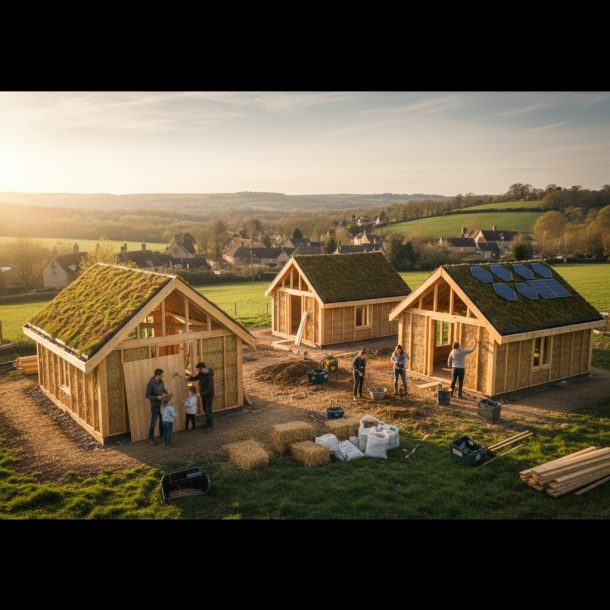
Built with low-carbon materials, impeccable landscape design, and tied to the village character.
✔ A parcel turned into a habitat bank or registered BNG unit site
Providing 30-year secure income while supporting local nature recovery.
✔ A strip gifted or leased to the community for green space, allotments or education
Strengthening the farm’s legacy in the village for generations.
These are not speculative ideas. They’re deliberate diversification ventures deeply linked to local need. And when managed with care, they allow the rest of the farm to stay intact – and stay in the family.
Imagine a 10-15 acre block on the edge of a village:
Nothing replaces farming. Everything supports it.
The majority of land remains in family hands. The farm continues – but with deeper roots and stronger resilience.
Farming has always carried uncertainty. But the last few years have been something else entirely – a perfect storm no one could navigate alone.
At Hamilton Oak, we see our role as simple:
Help farmers keep farming. Help the land keep earning. Help families keep holding what generations built.
Because in Oxfordshire, “local fields for local people” only works if the people who steward those fields can actually afford to keep them.
And that’s what we’re here to help protect.